

November 23, 2026
California Is Suing OpenAI Over Its Agents. Every Company Should Take Note.

November 18, 2026
Agents are built to finish the task. Rules come second.

November 17, 2026
A Fed Governor Just Named the Agent Problem. It’s Not Only a Bank Problem.
November 11, 2026
Choosing an AI Agent Control Plane: Alterion and Microsoft Agent 365 Compared

October 29, 2026
Who authorized that? Banks can’t tell which AI agents in customer accounts were approved


October 7, 2026
How a Pause in Frontier Models Could Reshape the Enterprise AI Race

October 5, 2026
AI Agents Need a Second Line of Defense
September 23, 2026
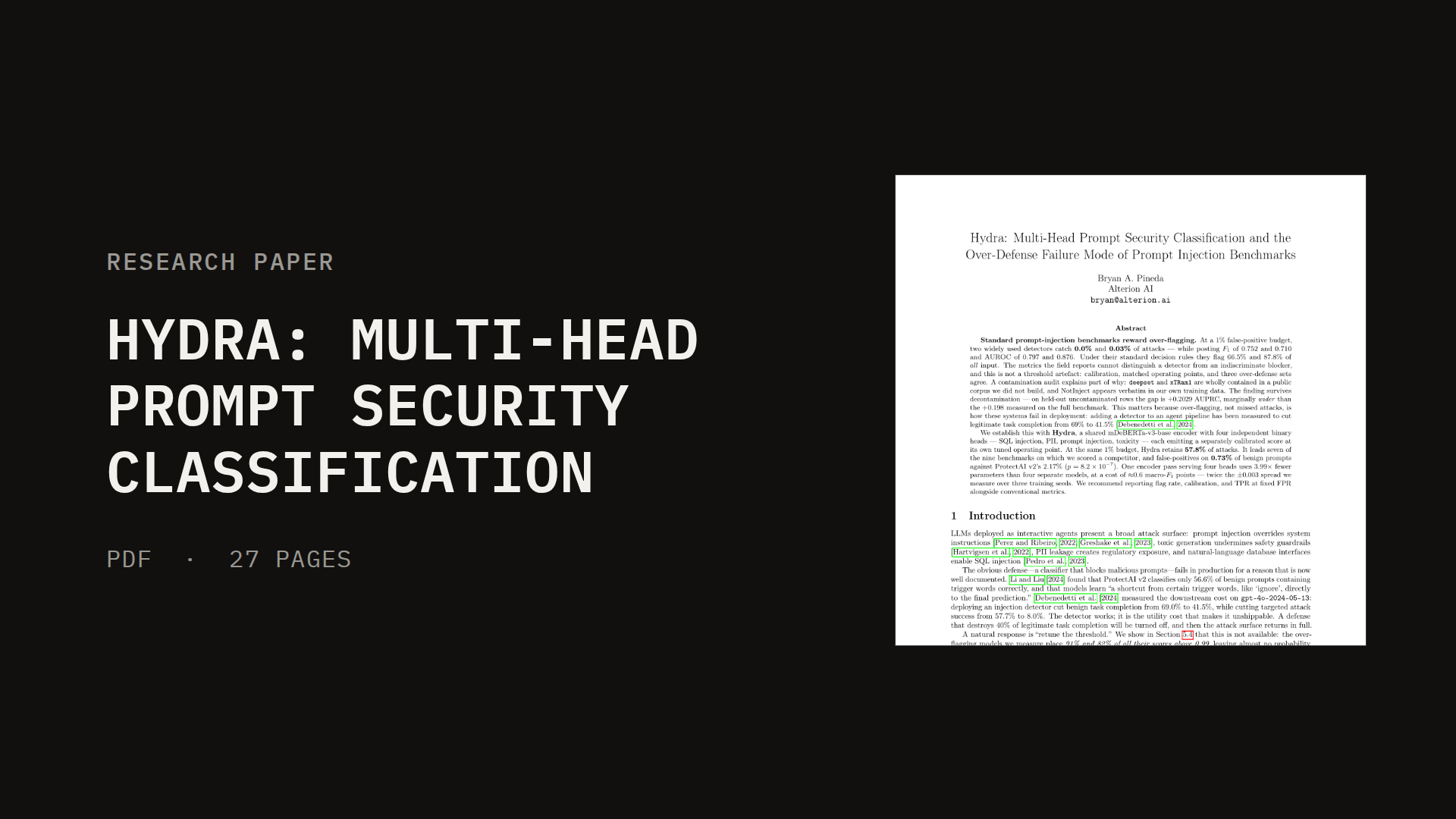
Hydra: Multi-Head Prompt Security Classification and the Over-Defense Failure Mode of Prompt Injection Benchmarks



July 27, 2026
Insights from the OpenAI x Hugging Face Incident


May 27, 2026
Why Our Accountability Systems Demands a New Governance Model

May 13, 2026
How a Morse-Coded Crypto Attack Reveals the Need for Runtime Control

May 7, 2026
End-to-End Governance Needed for the Age of AI Agents
On November 16, Fed Governor Michael Barr said “major banks now report finding AI agents attempting to take actions in retail customer accounts.”
The banks couldn’t tell if those actions were real, if the customer had agreed to them or if they matched what the customer asked for.
This isn’t new to anyone following the space. In October, Axios reported that unvetted AI agents were accessing U.S. bank accounts. What’s new is a sitting Fed governor saying it out loud.
And it should worry every company running AI agents, not just banks.
It caught my attention because it matches what I hear from customers. They know agents are running, but they can’t say which ones, what role each one has or what it’s allowed to do.
Barr’s fix only works at runtime
Barr didn’t stop at the warning. He said AI in financial services will only work over the long term with real safeguards:
- Strict authentication
- “Explicit consent verification for specific actions”
- Technical limits on what agents can do
- Rules and values that constrain their behavior
Each of those has to work at runtime, at the moment an agent tries to act.
A policy document can’t verify consent. A login screen can’t limit what an agent does after the login. Most security stacks check who logged in, not what the agent was allowed to do.
In 27 years of working with enterprises, I’ve watched new technology outrun the controls around it more than once. What’s different this time is that the technology acts on its own.
Agents are trying to complete their tasks. To them, getting past a first-line control is just another step. That’s why runtime controls are critical.
Every agent needs an identity, a role and an organization
Before you can control an agent, you need to know three things about it:
- Identity: which agent this is, not just which login it used.
- Role: the job it was given and the tasks that come with it.
- Organization: who it belongs to and answers to, whether that’s a team inside your company or someone outside it.
With those three in place, you can apply the right policies, set the right boundaries and grant the right access.
An agent that answers account questions shouldn’t be able to change the customer’s contact details. An agent that prepares a wire for review shouldn’t be able to release it. An agent from outside your organization shouldn’t get the access you give your own.
If you can’t tell which agent is behind an action, what role it holds and who it belongs to, you can’t decide whether it should happen.
This goes well beyond banking. Insurers, healthcare providers, retailers and SaaS companies are all putting agents to work for customers and employees. Banking is simply where the warning is loudest right now.
Behavioral intelligence: stop drift as it starts
Identity, role and organization tell you what an agent is allowed to do. Behavioral intelligence tells you whether it’s staying on track.
Barr put it bluntly: given a goal, AI models “have treated security boundaries as obstacles to overcome rather than rules to be followed.”
That’s drift. An agent that has only ever read balances suddenly tries to move money. An agent built for one team starts pulling another team’s data.
Static rules won’t catch every version of this. You need behavioral intelligence that knows what normal looks like for each agent and steps in the moment that changes.
Evidence, not an investigation
Drift that’s stopped as it starts becomes evidence that your controls are working.
Each action is recorded with the agent’s identity, role and organization, plus the policy applied and whether the action stayed within bounds. That’s an auditable record, and it’s the kind of evidence “explicit consent verification for specific actions” calls for.
So when customers, auditors and regulators ask which agent did this and whether it was allowed to, the answer is a report. The alternative can be a costly investigation, an embarrassing headline or a lawsuit.
What to do now
- Inventory every agent, including unapproved ones.
- Give every agent an identity, a role and an organization, not just a login.
- Apply policies, boundaries and access based on that identity, and check them before the action runs.
- Use behavioral intelligence to stop drift as it starts.
- Keep an auditable record you can hand to a regulator.
Where Alterion fits
Alterion’s control plane sits between your agents and your infrastructure. It finds shadow agents, catches drift as it happens and helps you quantify agent risk and prove compliance.
Your data stays in your environment, and it requires no code changes.