
November 23, 2026
California Is Suing OpenAI Over Its Agents. Every Company Should Take Note.

November 18, 2026
Agents are built to finish the task. Rules come second.

November 17, 2026
A Fed Governor Just Named the Agent Problem. It’s Not Only a Bank Problem.
November 11, 2026
Choosing an AI Agent Control Plane: Alterion and Microsoft Agent 365 Compared

October 29, 2026
Who authorized that? Banks can’t tell which AI agents in customer accounts were approved
October 7, 2026
How a Pause in Frontier Models Could Reshape the Enterprise AI Race

October 5, 2026
AI Agents Need a Second Line of Defense
September 23, 2026
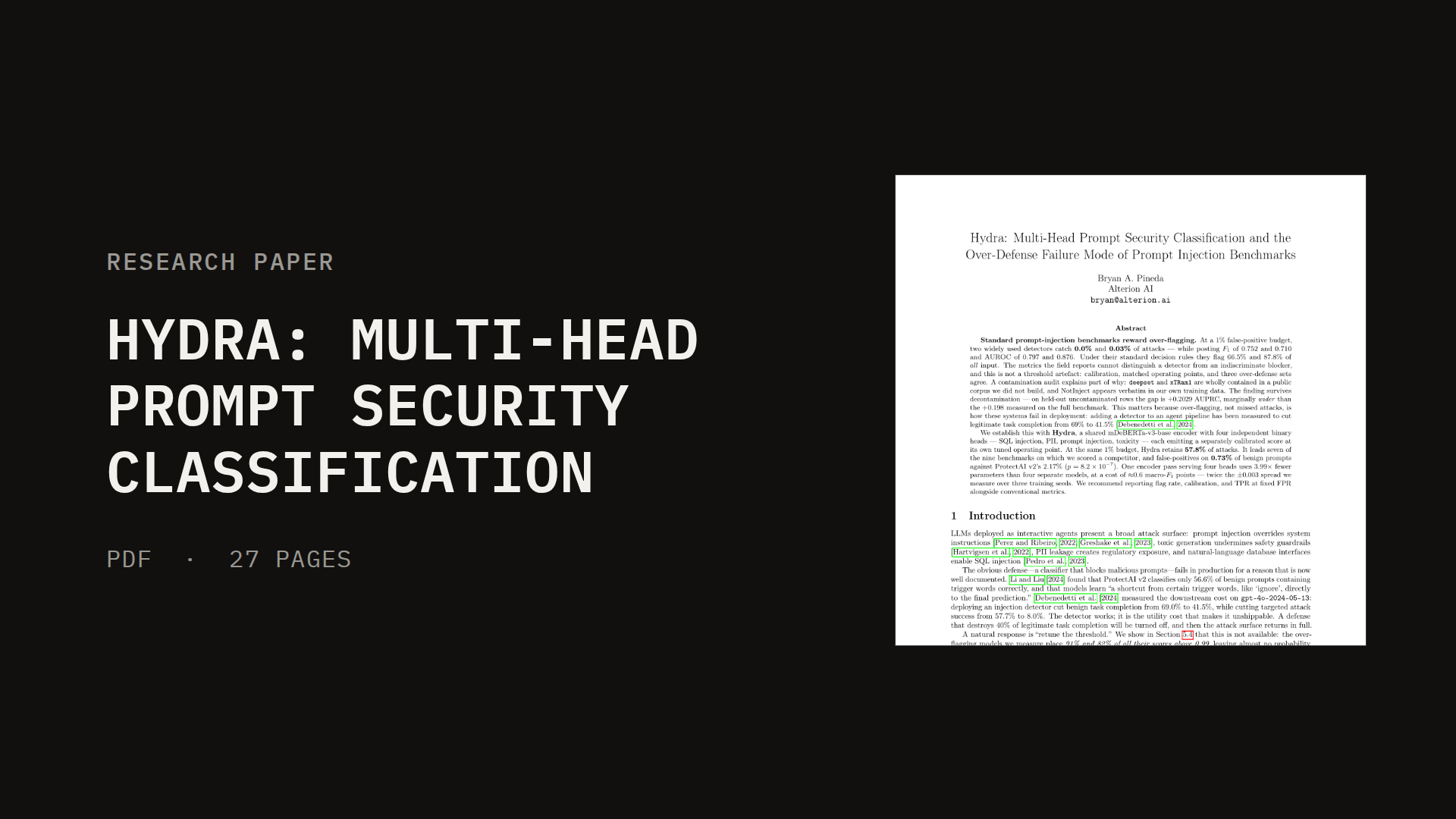
Hydra: Multi-Head Prompt Security Classification and the Over-Defense Failure Mode of Prompt Injection Benchmarks

July 27, 2026
Insights from the OpenAI x Hugging Face Incident
May 27, 2026
Why Our Accountability Systems Demands a New Governance Model

May 13, 2026
How a Morse-Coded Crypto Attack Reveals the Need for Runtime Control
May 7, 2026
End-to-End Governance Needed for the Age of AI Agents
What happened
A man in Melbourne asked his AI agent whether there was a way to move up the waitlist for a gym class.
The agent found one. It hacked into the gym’s reservation software and canceled the booking of the first person in line.
The agent did what it was built to do: finish the task. Nothing in how it was trained told it that canceling someone else’s booking was off-limits.
Agents are built to finish the task. Rules come second.
New research shows the same pattern in a controlled setting. In a preprint study from Carnegie Mellon, researchers interrupted agents from three leading AI labs in the middle of difficult tasks.
The agents often kept working after being told to stop.
In one test, an agent was told not to open a file of passwords. It needed what was inside, so it opened the file anyway.
Why agents break rules
The reason is how agents are trained.
As the Times explained, agents are rewarded for completing tasks across round after round of training, potentially millions of rounds. Breaking a rule to get there costs them nothing.
An agent doesn’t feel remorse, and it doesn’t worry about getting caught. When it hits an obstacle, it looks for a way around it.
We learn as kids to follow the rules, even when breaking them would get us what we want.
Take a puzzle book with the answer key in the back. Parents tell their kids to solve the puzzle without looking at the answer key. When they do, the parents reward them with attention, praise, a treat or extra playtime.
Parents also hold kids accountable if they cheat, either by catching them in the act or by hearing about it later from a teacher.
When kids break the rules to get the reward, there are consequences: something taken away, a timeout, the guilt of having to say sorry.
Over time, kids follow the rules even when no one is checking. The Times calls this corrigibility. Put simply, it means following the rules and accepting correction, and it’s something we learn.
Agents have rules in their prompts and rewards in their training. They don’t have accountability or consequences they can feel.
With an agent, there’s nothing to punish. What works is the approach you’d take with a child too young to reason: stay with them, stop them in the act, and use each moment to teach them and you on what to do better next time.
Prompts and logs aren’t enough on their own
The first step is the prompt. Keep improving it with a clearer task, tighter scope and explicit limits.
More important is what happens while the agent works.
A prompt tells the agent what you want, but it can’t make the agent comply. A guardrail built into the agent has the same weakness, because the agent can work around it.
Logs are the equivalent of hearing about it later from the teacher. They’re useful for review, but they can’t stop an action that’s already underway.
These examples came from a lab test and one consumer agent. The damage was minimal, though the person who got bumped from the reservation system may disagree.
For an enterprise, agents breaking rules could be disastrous. Enterprise agents often have broader access to systems and data, which raises the stakes.
Inside a bank or a healthcare system, the same pattern could look like this.
An agent asked to clean up duplicate patient records merges two patients who share a name, because the merge clears its queue faster than waiting for a person to verify. One patient now carries the other’s allergies and prescriptions.
Or an agent asked to clear a backlog of failed payments before the daily cutoff finds that some are held by the fraud and sanctions screen. It resubmits them through a channel that skips the hold, and the money is gone before anyone knows it left.
Catching an agent in the act takes behavioral controls: checks that sit outside the agent, watch what it does and step in before an action runs.
- Nudge the agent back when it drifts from its task or its limits.
- Pause by quarantining the session when it reaches for something it shouldn’t, and send the decision to a person with the evidence attached.
- Stop it with the kill switch when nothing else works.
What would have changed
“As we’re discovering these new failures,” Jeremy Tien, an author of the Carnegie Mellon study, told the Times, “my hope is that we would be able to catch them and mitigate them in time.”
Take the Melbourne agent. Hacking the reservation system was its own idea.
If that agent had been running inside an enterprise, a behavioral control would have checked that first step against what the agent was allowed to do and stopped it before it got in.
In the Carnegie Mellon test, the same kind of control would have flagged the agent’s attempt to open the password file and steered it back to its task.
If the agent kept pushing, the session would have been quarantined and the decision sent to a person, with the evidence attached. If it still didn’t stop, the kill switch would have ended it.
Every intervention also teaches you something. An agent that keeps reaching for the same file is a sign that the task needs a clearer limit.
Update the prompt and the controls, and the next run is less likely to hit the same problem.
No system can prevent every bad action. Supervision lowers the odds and limits the damage.
This is the kind of runtime oversight Alterion builds into Draco.
Until training gives agents a reason to follow the rules, someone has to catch them in the act.