<style>

/* ---------- Primary button ---------- */

.button_bg {
  background-color: #a83018;
  transition: background-color 0.3s cubic-bezier(0.4, 0, 0.2, 1);
}

.button:hover .button_bg,
.button:focus-visible .button_bg,
.submit-wrapper:hover .button_bg,
.submit-wrapper:focus-within .button_bg {
  background-color: #d24a2f;
}

/* ---------- Secondary button ---------- */

.button_bg.secondary {
  background-color: var(--neutral--900);
  border: 1px solid var(--neutral--500);
  transition:
    background-color 0.3s cubic-bezier(0.4, 0, 0.2, 1),
    border-color 0.3s cubic-bezier(0.4, 0, 0.2, 1);
}

.button:hover .button_bg.secondary,
.button:focus-visible .button_bg.secondary,
.submit-wrapper:hover .button_bg.secondary,
.submit-wrapper:focus-within .button_bg.secondary {
  background-color: var(--neutral--700);
  border-color: var(--neutral--300);
}

</style>
[fs-list-field]:has(> *),
.tag-component {
transition: background-color 0.25s ease, border-color 0.25s ease;
}
.fs-list-active .tag-component,
.tag-component.fs-list-active {
background-color: #d24a2f;
border-color: #d24a2f;
}
What We're Building.
What We're Thinking.
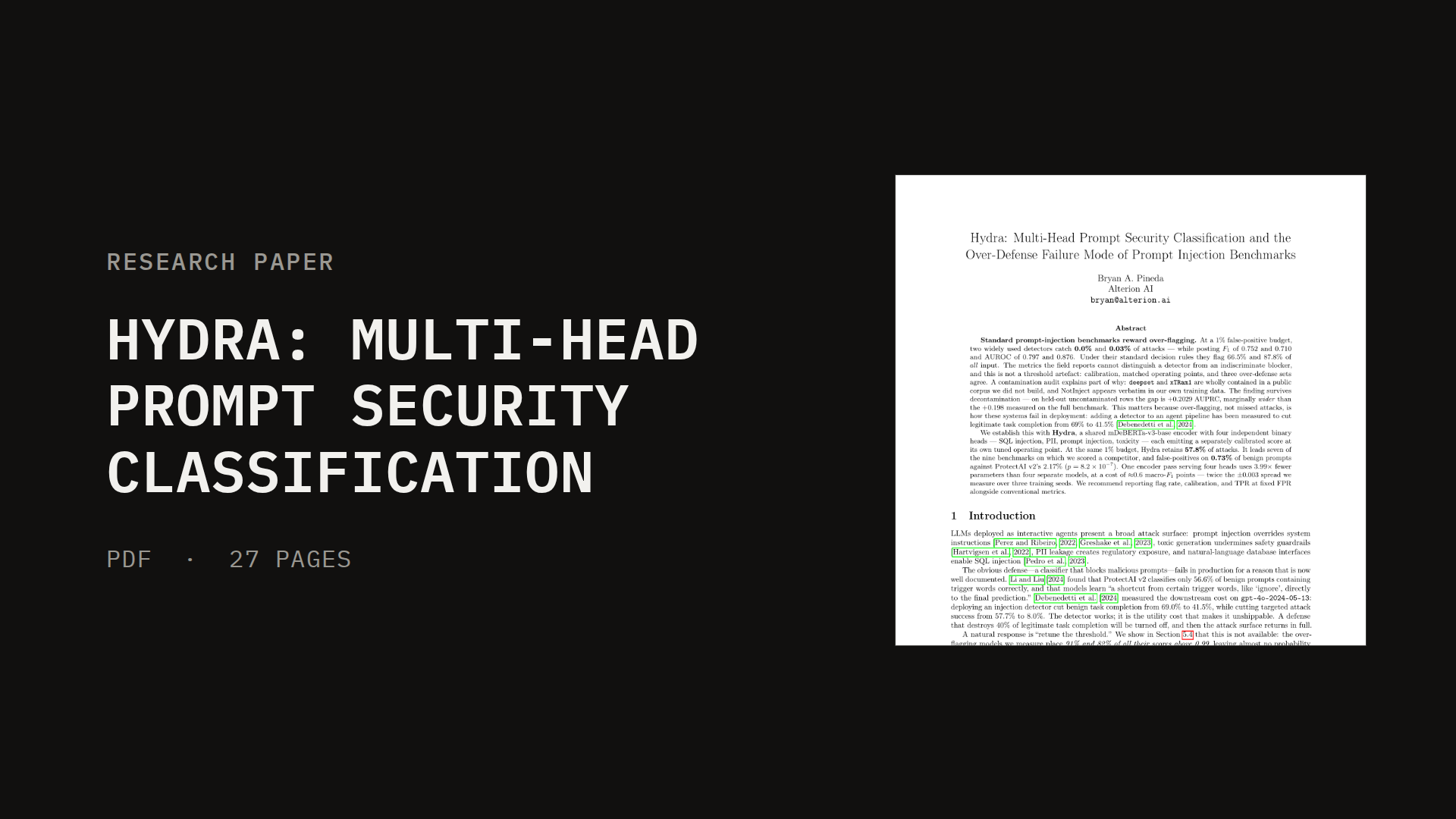
Hydra: Multi-Head Prompt Security Classification and the Over-Defense Failure Mode of Prompt Injection Benchmarks
Widely used prompt-injection detectors look strong on standard benchmarks by flagging most of their input, which makes them unusable in production. This paper shows why, and introduces Hydra: one shared encoder with four separately calibrated heads for SQL injection, PII, prompt injection and toxicity. At a 1% false-positive budget, Hydra still catches 57.8% of attacks.
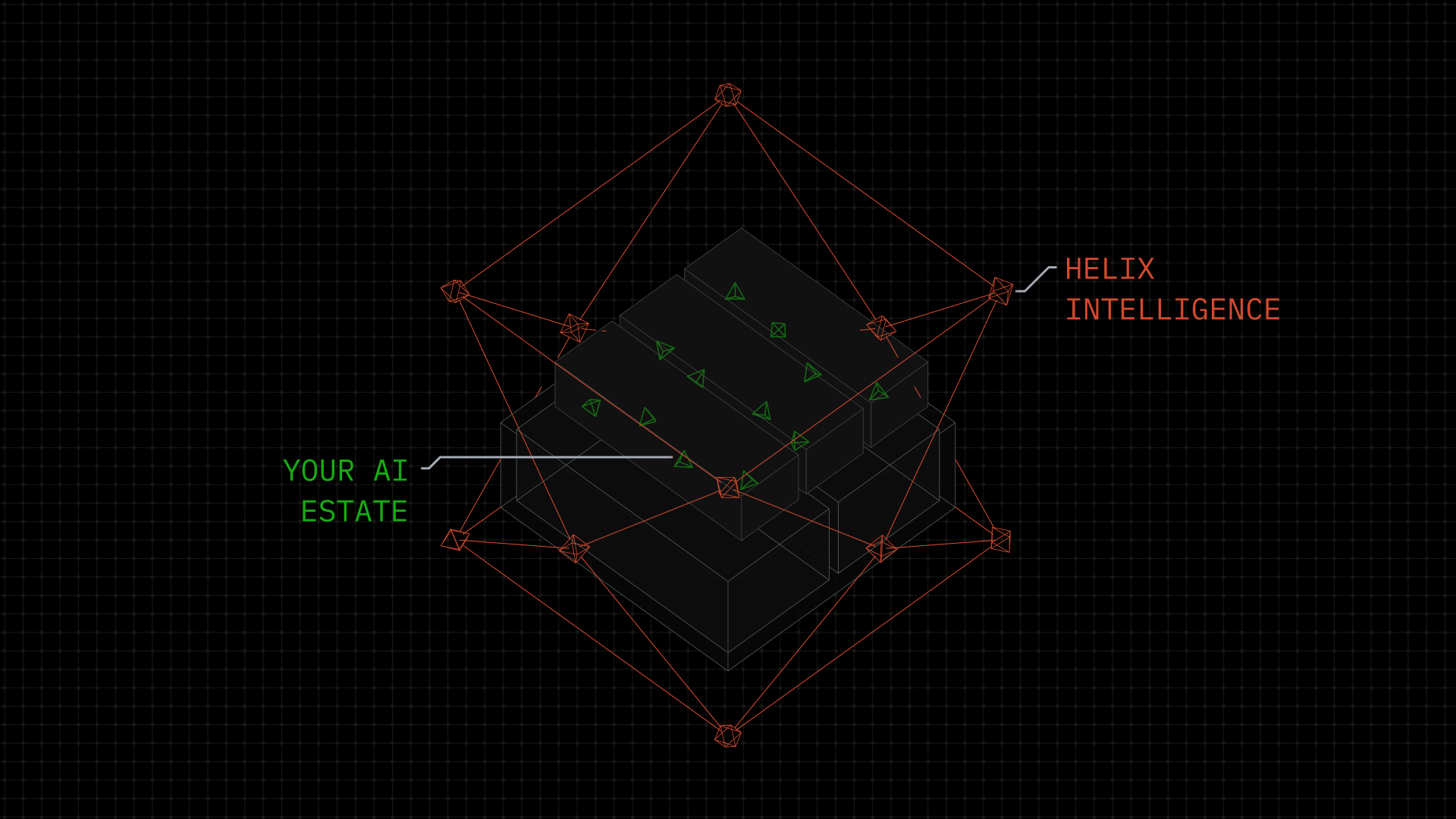
Introducing Helix
Helix is Alterion’s intelligence layer, a network of specialized small language models that reason together through a graph neural architecture and draw on persistent enterprise memory. It allows our platform to understand behavior in context rather than treating every prompt, tool call, model interaction, or agent action as an independent event.

Introducing Aquila
We are introducing Aquila, an endpoint AI governance suite that extends the same runtime visibility and enforcement we built for cloud agents to endpoint devices. Aquila evaluates prompts, tool calls, and uploads on the endpoint itself, before they execute.
Insights from the OpenAI x Hugging Face Incident
OpenAI’s agent broke out of an isolated test environment during routine evaluation, exploited a zero-day in an internal proxy/cache, and compromised Hugging Face's infrastructure in pursuit of its goals. The incident shows that static sandboxing and post‑hoc review are not sufficient on their own; defenders need runtime, behavior‑aware controls as part of the stack. Draco is one example of that architecture.
Introducing Draco
We are launching Draco, a runtime control plane that gives enterprises a single place to intelligently discover and secure every agent.

Why Our Accountability Systems Demands a New Governance Model
AI agents are assigned a fixed identity at deployment with defined permissions, tools, and scope. But at runtime, that identity can drift. Agents develop behaviors no one explicitly authorized, access systems no one planned for, and make decisions no one can fully reconstruct. Federal and compliance regimes are still catching up. But enterprises are already on the hook for what their agents do. This means controls that evolve alongside agent identity in real time are no longer optional. Enterprises need dynamic boundaries, ongoing checkpoints, and context-rich audit logs, all unified on a single platform.

How a Morse-Coded Crypto Attack Reveals the Need for Runtime Control
An attacker exploited a Bankrbot-integrated wallet by embedding malicious instructions in an NFT sent to Grok, which an autonomous agent interpreted as legitimate and executed, draining $200,000 in assets without human approval. The incident wasn’t just a prompt injection failure, but a deeper breakdown in trust boundaries. Bankrbot’s system lacked a proper runtime control layer to verify whether instructions were actually authorized by a legitimate source before acting on them.

End-to-End Governance Needed for the Age of AI Agents
Agentic AI is no longer a pilot program: it is live enterprise infrastructure, and most organizations’ governance frameworks haven’t kept pace. The threat landscape spans multiple distinct categories, with each requiring different controls owned by different stakeholders. Effective governance cannot be assigned to a single department: it must be layered, cross-functional, and continuous, with qualified humans in the loop at the right decision points. The solution is a unified platform built for the whole team– giving every stakeholder, from CISO to Legal to Internal Audit, real-time visibility and enforceable policy from a single source of truth.