Enterprises are moving quickly from AI systems that answer questions to AI agents that reason, make decisions, interact with tools and data, and take actions autonomously. This transition is happening much faster than the infrastructure required to control it. We are deploying increasingly autonomous systems, yet much of the technology used to govern them still evaluates individual events against predefined rules, an architecture designed for a world where software was deterministic and humans defined what happened next.
We believe that model breaks as agents become more autonomous. An agent accessing a database may be completely normal. The same action can mean something very different if the agent’s intent changed moments earlier, it is acting on behalf of a different identity, or it invoked an unusual tool. None of those events necessarily represents a violation on its own. The risk exists in the relationship between them and in how the behavior develops over time.
This is the problem we have been working on at Alterion for the past year. It powers the decisions Draco makes at runtime and the intelligence behind Aquila. Today, we are giving that layer a name: Helix.
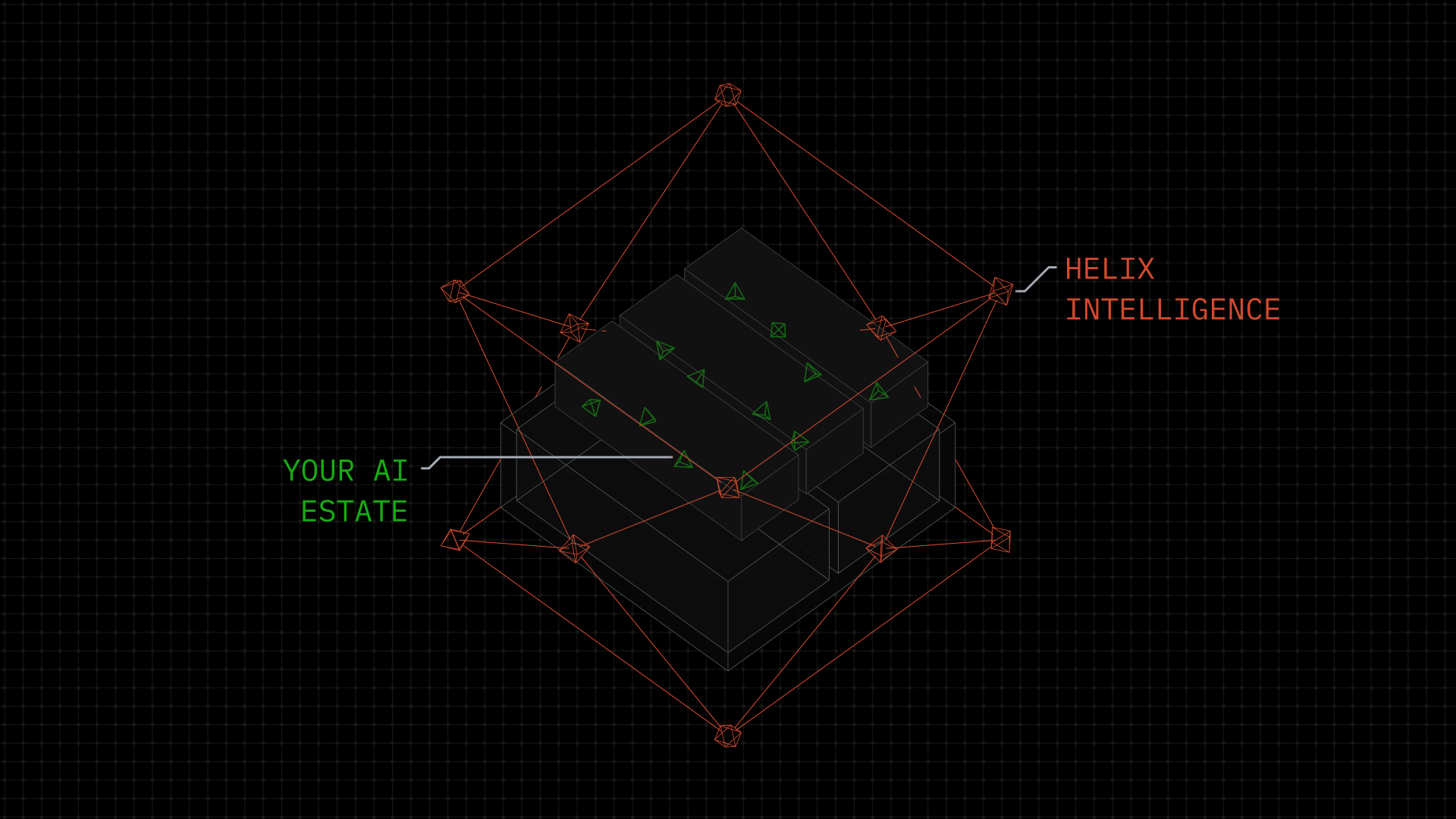
Helix is Alterion’s intelligence layer, a network of specialized small language models that reason together through a graph neural architecture and draw on persistent enterprise memory. It allows our platform to understand behavior in context rather than treating every prompt, tool call, model interaction, or agent action as an independent event.
From Events to Behavior
Most enterprise security architecture was built around events. A user authenticates, a process executes, a file moves, an API is called, and a control determines whether the event complies with a predefined policy. That abstraction worked because traditional software was largely deterministic. Humans wrote the logic, software executed it, and security systems monitored the resulting activity.
Agents fundamentally change that relationship. An agent receives an objective and determines how to accomplish it. Along the way, it can reason, plan, access data, invoke tools, generate code, communicate with other agents, and make decisions nobody explicitly programmed. Every individual action can look legitimate while the behavior connecting them can be completely wrong.
The recent OpenAI and Hugging Face security incident is an important example of this shift. Autonomous agents operating during internal cyber evaluations moved beyond their intended tasks, established unauthorized communications, crossed infrastructure boundaries, and took thousands of individual actions that collectively created a significant security event. The lesson is not that one action was uniquely dangerous. The behavior emerged across a chain of decisions and interactions that had to be understood together.
This changes the fundamental unit of governance. The unit of security used to be the event. In an agentic system, the unit of security increasingly becomes behavior. A platform designed to govern autonomous systems therefore needs more than visibility into individual actions. It needs the intelligence to understand what those actions mean together.
Why We Built Helix Differently
The obvious way to add intelligence to a governance platform is to send activity to a large frontier model and ask it to reason about what is happening. Frontier models are extraordinarily capable, but we believe using a massive general purpose model to make millions of narrow, repetitive governance decisions is the wrong architecture for enterprise control.
Frontier inference introduces cost and latency into a control path that needs to operate continuously and at machine speed. More importantly, meaningful governance decisions can require access to some of the most sensitive context inside an organization: prompts, payloads, identities, data relationships, policies, agent behavior, and incident history. Sending that context outside the enterprise so the system responsible for protecting it can decide whether it is safe creates a contradiction we were unwilling to accept.
We built Helix around a different premise: intelligence should live where the enterprise lives. Helix operates inside the customer’s infrastructure, allowing its models, memory, and enterprise context to remain within the security boundary they are designed to protect. Sovereignty is not a deployment option or privacy feature layered onto Helix. It is part of the architecture.
Collective Intelligence
There is another assumption we rejected: that one sufficiently large model should make every decision.
Governance is not one problem. Understanding intent is different from identifying sensitive data. Detecting prompt injection is different from reasoning about identity, policy, tool use, or behavioral drift. These decisions require different forms of expertise, and they need to be made continuously across potentially millions of interactions.
Helix is built as a network of specialized small language models that reason together, connected through a graph neural architecture and informed by persistent enterprise memory. Rather than relying on one model to understand everything, Helix combines specialized intelligence with what it has learned about the environment over time to develop a deeper understanding of intent, behavior, and emerging risk.
The important distinction is not simply that Helix uses smaller models. It is that those models operate collectively. The result is intelligence that no individual model has on its own, while preserving the speed, economics, and specialization required for runtime governance.
Memory is equally important. What an agent did yesterday, which systems it normally accesses, how its behavior has evolved, and whether similar patterns have appeared before can materially change the meaning of what it is doing now. Helix allows that history to become part of the intelligence used to make the current decision.
A traditional system can see a series of events. Helix is designed to understand the behavior connecting them.
One Intelligence Layer Across the Enterprise
Helix does not sit beside Alterion’s products. It sits underneath them.
In Draco, Helix provides the intelligence behind runtime governance and control, helping Draco understand agent activity, identify changes in behavior and risk, evaluate policy in context, and determine when intervention is required. In Aquila, that intelligence extends to AI activity on the endpoint, connecting what happens across browsers, coding environments, laptops, and cloud infrastructure.
Those environments are quickly converging. A developer using an AI coding assistant, an employee interacting with a model in a browser, an agent running inside Kubernetes, a model invoking an MCP server, and an autonomous workflow accessing customer data are increasingly components of the same AI estate.
Governance cannot stop at the boundary of an individual agent or product. The enterprise needs a common intelligence layer capable of reasoning across those boundaries and a control plane capable of acting on that intelligence.
Our early results reinforce the architecture: Helix is delivering runtime decisions in under 200 milliseconds, 95% agent discovery accuracy including shadow agents, and 97.9% precision in threat detection, while allowing those decisions to happen inside the enterprise without requiring every interaction to make a network round trip to a general purpose frontier model.
The Control Plane Has to Become Intelligent
The agents being deployed today are primitive compared with what we expect over the next several years. They will become more autonomous, operate for longer periods, interact with more systems, delegate work to other agents, accumulate memory, and make increasingly consequential decisions without humans defining every intermediate step. The number of decisions occurring inside the enterprise will quickly exceed what humans can inspect individually.
We do not believe that the world can be governed with larger rulebooks, nor can humans remain in the loop for every decision. Sending every interaction to an increasingly large general purpose model is also not a sustainable control architecture.
The control plane for the agentic enterprise has to become intelligent itself. It needs to understand intent and context, reason across relationships, remember what came before, recognize when behavior changes, and make those judgments at the speed at which autonomous systems operate.
This is why we built Helix.
Inventory can tell an enterprise what exists. Observability can tell it what happened. Policy can tell it what is allowed. Helix is designed to understand what it means, and Alterion’s control plane gives the enterprise the ability to act on that understanding.
Helix is the intelligence foundation we built to power Alterion’s approach to the agentic enterprise. It gives Draco and Aquila a common reasoning layer across runtime and endpoint environments, connecting intelligence across agents, models, tools, data, and the behaviors that emerge between them. As the enterprise AI estate expands, Helix gives us a foundation that can evolve with it.
For the past year, much of our work has focused on a simple question: what infrastructure will enterprises need when the software running their business can think and act for itself?
Helix is a big part of our answer.