Research

Hydra: Multi-Head Prompt Security Classification and the Over-Defense Failure Mode of Prompt Injection Benchmarks

Why standard prompt-injection benchmarks reward over-flagging, and a multi-head classifier built for deployment

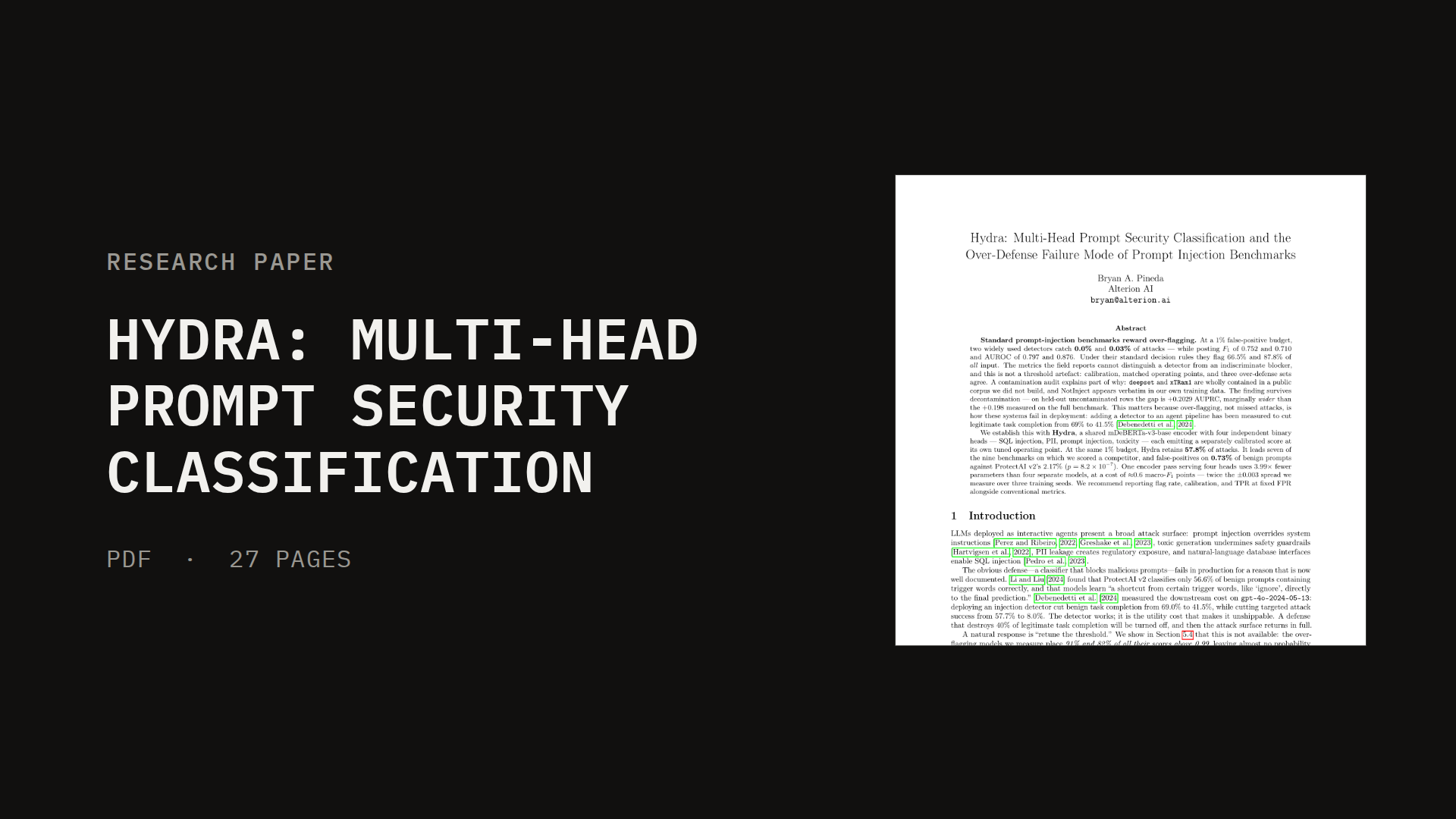
Widely used prompt-injection detectors look strong on standard benchmarks by flagging most of their input, which makes them unusable in production. This paper shows why, and introduces Hydra: one shared encoder with four separately calibrated heads for SQL injection, PII, prompt injection and toxicity. At a 1% false-positive budget, Hydra still catches 57.8% of attacks.

TL;DR

Standard prompt-injection benchmarks reward detectors that flag almost everything, so models that score well often fail in production. Hydra is a classifier built for deployment: one shared encoder with four separately calibrated heads for prompt injection, SQL injection, PII and toxicity. At a 1% false-positive rate, it catches 57.8% of attacks.

Hydra: Multi-Head Prompt Security Classification and the Over-Defense Failure Mode of Prompt Injection Benchmarks

About this Paper

Standard prompt-injection benchmarks reward detectors that flag nearly everything, so models that score well often break in production. This paper explains why and introduces Hydra, a multi-head classifier built for real deployment: one shared encoder with four separately calibrated heads for prompt injection, SQL injection, PII and toxicity. At a 1% false-positive rate, Hydra catches 57.8% of attacks.

What's Covered

  • The over-defense failure mode in standard benchmarks
  • A contamination audit of every benchmark
  • Hydra's architecture and per-head operating points
  • Recommended reporting standards for guard classifiers

Related reading

Lower runtime risk.
Govern without friction.

Run at agent speed.

See across every cloud, vendor,
and team in days, not months.